

-

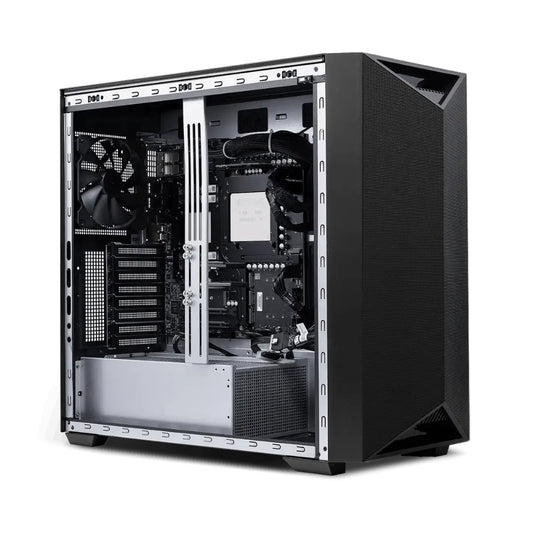
MSI XpertStation WS300 NVIDIA DGX Station Grace Blackwell Ultra Computer
Regular price RM539,000.00Regular price -

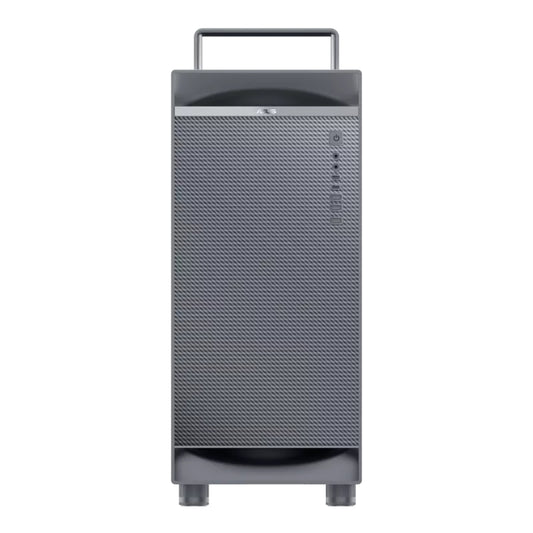
ASUS ExpertCenter Pro ET900N G3 NVIDIA DGX Station Grace Blackwell Ultra Computer
Regular price RM539,000.00Regular price -

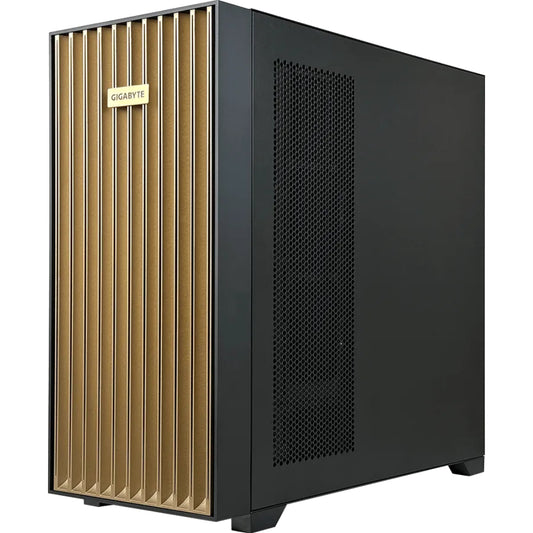
GIGABYTE W775-V10-L01 NVIDIA DGX Station Grace Blackwell Ultra Computer
Regular price RM485,000.00Regular price


FAQ
Questions, answered.
What NVIDIA DGX Station is, what it runs, what it costs in Malaysia, and how it compares to the alternatives.
-
What is NVIDIA DGX Station?
NVIDIA DGX Station is a desktop AI supercomputer built on the NVIDIA GB300 Grace Blackwell Ultra Desktop Superchip: a 72-core Grace Arm Neoverse V2 CPU paired with a Blackwell Ultra GPU over NVLink-C2C at 900 GB/s. It carries 748 GB of coherent memory in a single pool, 252 GB of HBM3e alongside 496 GB of LPDDR5X, and delivers 20 petaFLOPS of dense FP4 compute, rising to 153 petaFLOPS with sparsity. NVIDIA positions it for models up to 1 trillion parameters, running on a desk rather than in a data centre.
-
Who is DGX Station for, and what does it run?
It suits AI research labs, enterprise data science and ML teams, university HPC programmes, and businesses that need on-premise inference at scale. The shared need is running very large models locally without per-hour cloud GPU billing and without sending sensitive data off site.
Typical workloads: fine-tuning and training LLMs including SFT, RLHF, DPO, LoRA and QLoRA; multi-user inference partitioned across the GPU; agentic AI; vision-language and multimodal models; physical AI for robotics; and large-scale data science through RAPIDS.
-
What size AI models can DGX Station run, and can it fine-tune them?
NVIDIA positions DGX Station for models up to 1 trillion parameters. The 748 GB coherent pool is what makes that possible: the GPU and CPU memory are unified over NVLink-C2C, so a model does not have to fit inside GPU VRAM alone the way it does on a workstation card.
Practical ranges: 7B to 70B runs with excellent throughput and low latency, 120B to 200B is comfortable, 405B is production-feasible, and 600B to 1T is frontier work that previously needed a multi-node cluster.
Fine-tuning and training are both in scope, from pre-training small and mid-sized foundation models through SFT, RLHF, DPO, LoRA and QLoRA, continued pre-training on domain data, and RAG indexing. Where training outgrows a single unit, the platform composes into clusters over 400 Gb/s QSFP112 networking.
-
How much does DGX Station cost in Malaysia, and what do you get for the difference?
Current pricing for each build is shown on its card above and on its own product page, so this answer stays on what the difference actually buys. The silicon is identical across all three because NVIDIA fixes it, so what you are choosing between is the chassis, the cooling, the expansion, the lead time and the warranty service level.
- GIGABYTE W775-V10-L01: the most compact of the three, and and the only one that needs a C19 power cord, which is not supplied. Typically 10 weeks.
- MSI XpertStation WS300: the fastest to arrive at typically 4 to 6 weeks, and the only one of the three with published independent benchmark results.
- ASUS ExpertCenter Pro ET900N G3: the only one with on-site service at next business day, the only build publishing an acoustic figure, roughly 50 dB in Auto Mode at maximum load without a discrete graphics card fitted, and the only one with a Titanium-rated power supply. Typically 10 weeks.
Everything inside the superchip is identical across the three, because NVIDIA fixes it: the same 72-core Grace CPU and Blackwell Ultra GPU, the same 748 GB of coherent memory, the same 20 PFLOPS of dense FP4 compute, the same networking, the same three PCIe slots and four M.2 slots, and the same list of supported add-in RTX PRO cards. All three also need a 20 amp circuit, and none has a usable display output of its own, so a desktop needs an add-in card. All three carry a three-year warranty per the distributor quotation, with the ASUS the only one of them documenting on-site service at next business day. EMARQUE handles any RMA locally in Malaysia. Lead times run from the confirmed order. For a quotation, including NVIDIA AI Enterprise licensing or deployment scoping, use ENQUIRE NOW on any build.
Each product page carries the full specification for that build.
-
How does DGX Station compare to DGX Spark?
Same family, very different scale. DGX Spark runs the GB10 Grace Blackwell with 128 GB of unified memory, around 1 petaFLOP of FP4, models to roughly 200B with about 120B as the practical optimum, and draws about 240W. DGX Station runs the GB300 Grace Blackwell Ultra with 748 GB coherent memory, 20 petaFLOPS of dense FP4, models to 1 trillion parameters, GPU partitioning for up to seven users, and draws up to 1,600W.
In short, Spark is a personal AI development machine and Station is on-premise AI infrastructure. Most teams start on DGX Spark and move up when model size, user count or training scale forces it.
-
Should I choose DGX Station, an RTX PRO 6000 workstation, or an AI server?
It comes down to whether AI is the main job, and how many people share the machine.
- RTX PRO 6000 Blackwell: mixed AI and creator work, rendering, simulation and visualisation alongside AI, on a familiar workstation with 96 GB of GDDR7.
- DGX Station: AI is the primary workload, the models exceed what fits in 96 GB, several people need to share one box, or you are doing serious fine-tuning.
- Multi-GPU AI servers: one Station is not enough. Multi-node clusters, full data-centre deployments, and training that scales beyond a single GB300.
-
Can DGX Station serve multiple users at once?
Yes. NVIDIA Multi-Instance GPU partitions the Blackwell Ultra GPU into up to 7 fully isolated instances, each with its own memory, compute and L2 cache, so one unit can serve seven simultaneous users, models or workloads without them competing for resources. That is what makes a single Station viable as a shared department or research-team resource rather than one person's machine.
-
What software comes with DGX Station?
The unit ships with NVIDIA DGX OS, an Ubuntu base qualified and locked for AI work, together with the NVIDIA AI Developer Tools: CUDA, container runtimes, AI Workbench and pre-built framework images including PyTorch, vLLM, RAPIDS and NeMo. It boots into a working AI environment rather than a bare operating system.
NVIDIA AI Enterprise is a separate entitlement, licensed on its own rather than bundled with the hardware. If you need it, say so at the quotation stage and it is priced with the order.
NVIDIA has also announced a Windows variant of DGX Station. The units EMARQUE currently carries are the Linux configuration described above, so tell us early if Windows matters to your stack.
-
What networking does DGX Station have, and can units be clustered?
Each unit carries an NVIDIA ConnectX-8 SuperNIC rated up to 800 Gb/s, presented as two QSFP112 ports at 400 Gb/s each, plus a 10 GbE RJ45 for normal host networking and a separate management LAN. That is enough to compose units into a cluster for training that outgrows a single box, and to drop cleanly into an existing data-centre fabric.
ConnectX-8 and QSFP112 deployment, NCCL and MPI tuning, and rack-level networking are handled by the EMARQUE AI team as scoped work.
-
Why run AI on-premise instead of in the cloud?
Four reasons usually decide it. Privacy, where data sovereignty and PDPA obligations make sending personal data to a hosted service abroad a cross-border transfer with its own compliance burden. Predictable cost, against cloud GPU bills that grow with every hour of use. Latency, with no round trip for real-time inference or agentic loops. And control of the models, the weights and the full stack.
Cloud still wins on burst capacity and on getting started quickly. The case for a Station is strongest when the workload is steady, the data is sensitive, or both.
-
How does EMARQUE support a DGX Station deployment in Malaysia?
EMARQUE is a solution provider and systems integrator, not only a reseller. We have been building and deploying computing systems in Malaysia since 2016 and have worked with more than 300 Malaysian clients across enterprises, SMEs, research labs, universities, government agencies and creative studios, on private LLM stacks, on-premise RAG, document AI, computer vision and multi-GPU server integration.
On a DGX Station specifically the EMARQUE AI team handles sizing and configuration, ConnectX-8 and QSFP112 networking, MIG partitioning for multi-user serving, private LLM, VLM and RAG stack deployment, team training, and Malaysia-based post-sale support. Scope, timing and charges are quoted on enquiry.
The wider AI compute range, including DGX Spark with clustering of up to four units, RTX PRO Blackwell workstations and multi-GPU AI servers, sits under EMARQUE AI. Use ENQUIRE NOW on any product page, or email business@emarque.co.